Fifty Thousand Years Ago: When the World Was the Memory
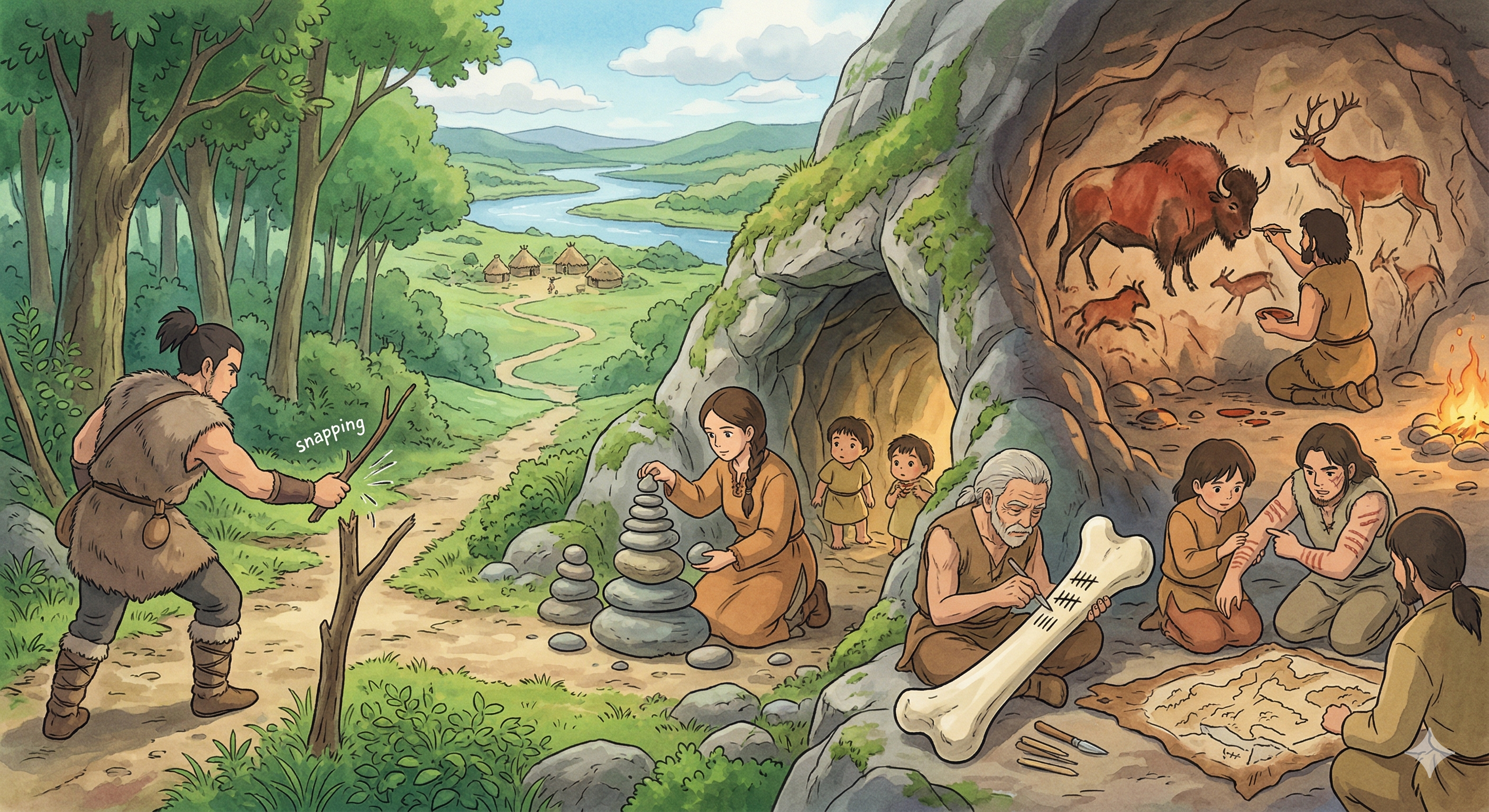
Tens of thousands of years ago, human memory was not fundamentally different from that of any other animal — it was biological, personal, and died with each individual. But at some point, humans made a profound discovery: they could make the environment remember for them. A hunter who broke a branch at a crossroads created an arrow that would guide him back to camp. A woman who arranged a pile of stones at the entrance to a cave told her children that mother had returned. Cave paintings, like those of Lascaux and Altamira, were not merely art — they were databases: which animal is dangerous, where it lives, how it looks while running. Marked stone heaps marked migration routes; notches in bones counted seasonal calendars; knots and scars on people's bodies served as living maps. Each of them represents the same revolutionary insight: knowledge can be stored outside the body and retrieved later. The total sum of “transmissible knowledge” suddenly grew beyond the realm of raw biological memory.
The Invention of Writing: The First Great Compression
When the Sumerians invented cuneiform some 5,000 years ago, they did not merely create a system of record-keeping — they performed the first act of compression in human history. Before writing, any knowledge to be passed to future generations required physical reenactment: teacher and student, generation upon generation, mouth to ear. Writing changed the entire equation. Now a truth that had taken years of human experience could fit on a single line of signs. A law that required judges to remember it by heart could be condensed onto a clay tablet. The grain-account details of thousands of households, which had previously required dedicated memory specialists — biological “knowledge managers” — were captured in a few lines of text. This was not just a new storage method, but a deep anthropological shift: for the first time, memory became public infrastructure. It was copyable, distributable, and correctable. And most important — the relative share of the “live” memory in any individual's head, against the total memory of society, began to shrink in a way that has not stopped since.
The Book: A Compression That Needs a Key to Open
But writing, and after it the book, exposed a fascinating paradox. A book is not simply “stored memory” — it is compressed memory, and compression requires a decompression key. Take a graduate-level mathematics textbook — say, differential geometry or measure theory. For most human beings, those pages are no more than foreign signs on paper. The information is lying there, but it is completely opaque — like an encrypted file without a password. But that same book, in the hands of a student who has completed two years of linear algebra, real analysis, and topology, becomes a tool of extraordinary power. Each short theorem unfolds for them into a chain of insights. Each compressed proof reconstructs in their mind into an entire landscape of ideas. The book does not transmit information alone — it transmits information when it meets experience, and that combination produces knowledge that is by no means trivial. In this sense, the book is essentially an interface: a connection point between compressed external memory and the internal memory built up over years of study. The richer the internal memory, the more the book “downloads” into the reader's consciousness — like a compressed signal that opens to its full size only in an environment that has the algorithm to decode it.
The Printing Press: When Knowledge Became Stable
Until the fifteenth century, even after the invention of writing, a hidden enemy still reigned in the world of knowledge: error. Every book copied by a scribe — even the most skilled — carried a slight deviation from the original. A word swapped, a number misplaced, a paragraph dropped by a wandering eye. Over generations of copying, texts “wore down” — like a photocopy of a photocopy of a photocopy. When Gutenberg operated his printing press in the 1450s, he changed something fundamental: knowledge became stable. A thousand copies of the same book were identical to the last letter. But the change did not stop there. The production time of a book plummeted from whole days of manual labor to a few hours for dozens of copies at once. Suddenly knowledge opened to another order of magnitude of distribution: no longer just monasteries and royal courts holding books as a precious secret, but universities, merchants, and physicians who could all hold in their hands the same exact text. The press did not merely accelerate the spread of knowledge — it changed its nature. Knowledge that could be reproduced exactly and distributed across a continent became, for the first time in history, a reliable public infrastructure on which one could build.
The Press as an Engine of Engines
But the press's deep impact was not only that it copied books faster — it was that, for the first time, it created the infrastructure on which human knowledge could accumulate momentum. Before the press, any scientist or philosopher who wanted to build on a predecessor's work often needed to obtain the original text himself, or rely on quotations from others — who themselves perhaps knew only a copied, garbled version. The press changed this from the ground up. Scientists in England and Italy and the Netherlands could now read the same exact edition of the same experiment, respond to it, and publish their response — and others could read that too. Knowledge ceased to be a chain of one-to-one transmission and became a network. The Scientific Revolution of the sixteenth and seventeenth centuries — Copernicus, Galileo, Newton — is no accident. It bloomed precisely in the generation in which the press reached full maturity. Suddenly Newton could stand on the shoulders of giants — not as a metaphor, but as a technically feasible task: read, understand, and continue. The press did not merely spread knowledge — it made human knowledge cumulative.
From Press to Digital: Three Centuries of Acceleration
In the three centuries between Gutenberg and the first computer, human knowledge did not stand still — it accelerated steadily, wave after wave. Every new technology of record and distribution added another layer on top of the press: scientific journals, which began to appear in the seventeenth century, created for the first time a mechanism of continuous update — instead of a book published once in years, a paper distributed within weeks. The telegraph and the telephone shortened the transit distances of information from months to seconds. Radio and television made distribution massive in a way Gutenberg himself could not have imagined. And in each of these leaps the same pattern recurred: more knowledge, faster, to more people, with less loss and distortion along the way. But throughout this period one deep limitation still reigned: knowledge remained physical. Books took space. Archives took buildings. Copying required paper and ink. Catalogs required librarians. In the 1940s and 1950s, when the first computers were born, the world stood on the verge of a transition unlike any since the press — a transition in which the physical limitation of knowledge would dissolve almost completely.
Digital Knowledge: When Information Shed Its Body
The digital revolution did something to knowledge that had never happened before — it severed it completely from matter. A book takes space, wears out, burns, and reaches one reader at any moment. A digital file does none of these. Copying it costs nothing, takes no meaningful time, and produces no version inferior to the original — the copy is as perfect as the original, exactly, without exception. But the digital did not merely free knowledge from matter — it changed all the proportions. A national library that contains millions of volumes and requires a vast building, a staff of hundreds, and a state budget — fits entirely on a hard drive that can be held in the palm of a hand. Then came the internet, and abolished the limitation of distance, too. Knowledge created in Tokyo is available in the same second in Tel Aviv and Buenos Aires. An encyclopedia that took decades to build and hundreds of experts — is now updated as one continuous living stream, by millions of people, in every language simultaneously. But beyond all this, the digital brought with it an innovation that is perhaps the deepest of all: knowledge became searchable. No longer a librarian who remembers where a thing is — but a one-second query that finds a needle in a haystack of billions of pages. Slowly, the remaining limitation was no longer where knowledge is stored, nor how much of it exists — but who could understand it.
From Storage Tools to Thinking Tools
So far, all the technologies we have described — from the notch in the mammoth bone to the internet — have dealt mainly with one question: where to store knowledge and how to transmit it. The personal computer quietly opened an entirely new chapter. For the first time, the tool did not merely store knowledge — it could act on it. A spreadsheet is not just a number store — it computes them, reveals patterns, and presents results that a person would need hours to reach. A word processor is not just a sophisticated typewriter — it organizes, searches, and suggests. Then came data-analysis software, and after it search engines, and after them millions of applications, each of which is in effect knowledge embedded as action: medical knowledge that becomes a diagnostic app, geographic knowledge that becomes navigation, financial knowledge that becomes automatic budget planning. Humanity discovered that it could not only store knowledge in the external environment — it could make the external environment think with that knowledge, and do so fast and without fatigue. The share of the human brain in the total processing of human knowledge — not only in storage but also in processing — began to shrink in a measurable way.
The Bottleneck: Who Can Build the Tools
But here the digital revolution ran into a new — and surprising — limitation. Knowledge itself became accessible to all, but the ability to build tools that operate on knowledge remained the province of the few. Writing code — that is, creating what we might call “operators on information,” manipulations that process knowledge, filter it, compute it, and present it in a new form — requires a skill acquired over years. A programmer who wants to build a tool that analyzes medical data, or organizes research by topic, or searches for patterns in a vast database — needs years of training, and then days and weeks of work for each new tool. And most of the people who have the necessary knowledge — the doctor who knows which medical questions are important, the economist who knows which economic patterns are interesting — do not know how to write code. And those who know how to write code are mostly not doctors and not economists. So a gap was created: the knowledge exists, the tools to process it exist, but the ability to create new operators on new knowledge remained concentrated in the hands of a small minority, each of whom is further constrained by the bottleneck of time.
Language Models: When Thinking Also Left the Head
Then came the language models, and closed the loop in a way no one quite anticipated in full. Until that moment, the process of taking human knowledge out into the external environment had passed through two stages: first, the knowledge itself — the facts, the theories, the data — went out, from the brain to the tablet, to the book, to the server. Second, as we saw, the processing of knowledge also began to move outward, but got stuck at the bottleneck of those who could write code. Language models broke that bottleneck completely. Now, anyone who needs a new operator on knowledge — a tool that analyzes, summarizes, organizes, compares, translates, infers — no longer needs years of study and weeks of development. They need minutes of conversation. The doctor can build an analysis tool without learning to program. The economist can extract patterns from a database without knowing SQL. It is the year 2026, and the most remarkable thing is not the speed — it is the level. The knowledge that language models have accumulated, and the digital operations they are capable of performing, in practice exceed the abilities of the vast majority of human beings in most domains of knowledge. This historical moment carries a deep meaning: not only is the relative share of human memory in the total memory steadily shrinking — now, also, the relative share of human thinking in the total thinking has begun to shrink, at a speed we have never seen before.
Avra K'davra: The Return of Magic
But the story does not end with thinking. Fifty thousand years ago, the hunter broke a branch — and in that simple gesture performed the first act of taking knowledge out into the world. The physical sign in the environment did not merely represent intention — it embodied it. Since that broken branch, humanity has gone on a long journey of taking capabilities out of itself: first memory, then knowledge, then thinking. But always one last gap remained between thought and physical reality — a gap filled by human hands, and machines, and labor. The age of robotics is the next step in this series. Just as language models took the operators-on-knowledge out of programmers' brains — so robots take the operators-on-the-physical-world out of human hands. Building buildings, manufacturing machines, processing materials, waging wars — all of these are gradually becoming actions that originate in intention, not in toil. And the next stage, the edge of which is already visible, is the deepest: a world in which thought itself creates reality — in which intention, processed in a computer and applied by a robot, becomes directly an object, a structure, a system. This is Avra K'davra — in the original Aramaic: “Avra” from “ev'ra,” I will create, and “K'davra” from “k'divura,” like my word. What my mouth speaks — will be created. Humanity, which began with a broken branch on the forest floor, arrives in 2026 at the threshold of an era in which the distance between thought and reality is shrinking to nearly zero. It is not by chance that the ancients called this magic. We simply discovered that the magic was always there — it had only been waiting for the right technology.