For most of the last fifty years, building a serious product meant accepting a quiet truth: you would probably only ever own one layer of the stack. If you made chips, you didn’t make devices. If you made devices, you didn’t make the software. If you made the software, you didn’t handle distribution. If you handled distribution, you certainly didn’t deal with regulation. There were exceptions, of course, but for the most part that was how the world functioned. Each layer was its own world — its own talent pool, its own capital requirements, its own decade of learning curves — and the only companies that dared to span the whole stack were the giants. Apple. Tesla. Samsung. A handful of others. Everyone else picked a slice and tried to be the best in the world at that slice, because that was the only honest way to survive.
This was not a strategic choice. It was a physical constraint. Vertical integration required armies — tens of thousands of engineers, designers, lawyers, marketers, supply chain operators, compliance officers, technicians. The cost of coordinating that many humans was so enormous that only companies with hundreds of billions of dollars in revenue could absorb it. The rest of us specialized, because specialization was almost the only thing the economics allowed.
That constraint is dissolving in front of us, and most people haven’t fully registered what it means yet.
The two faces of the same shift
There are two ways to see what AI is doing to the stack, and they are both true at the same time.
The first view: the giants who already do everything will now do everything with a fraction of the people. Tesla, in five years, will not need to triple its headcount to triple its capability. It will need to get smarter about what it already has. The same engineers, augmented by agentic systems, will design more cars, write more firmware, navigate more regulatory regimes, and run more factories than they ever could before. The vertical organization survives — but its human density per unit of output collapses. The org chart shrinks while the surface area grows.
The second view, which is the more interesting one: verticality is no longer the privilege of giants. Small and medium-sized companies — the ones that for decades had to pick a single layer and live there — can now span the entire stack themselves. A team of forty people can do what a team of four thousand used to do. Not in every domain yet, but in more domains every quarter. The threshold for being Apple-shaped or Tesla-shaped, in miniature, is dropping fast enough that you can watch it happen in real time.
These are not contradictory views. They are the same phenomenon seen from opposite ends of the size spectrum. The giants get leaner; the small get broader; and the middle — the place where most real innovation actually happens — becomes radically more capable than it has ever been.
What actually got cheap
To understand why this is happening, you have to look at which layers AI has already eaten, or is in the process of eating. The list is longer than most operators realize:
- Software architecture and implementation. A senior engineer with agentic tools can now design, scaffold, and ship systems that used to require a team of eight. Not by replacing the engineer, but by collapsing the time between intention and working code.
- A large share of regulatory work. Reading, mapping, drafting, and cross-referencing regulatory frameworks — FDA, CE, MDR, ISO, GDPR, whatever the alphabet soup of your sector — used to require dedicated specialists or expensive consultancies. Models trained on these corpora now do the first 70% of that work in hours instead of months.
- Financial modeling, accounting hygiene, and operational reporting. The CFO-adjacent work that used to require a small department is increasingly handled by a single operator with the right stack.
- Marketing, content, brand systems, customer communications. What used to be an agency engagement is now a prompt loop with a human editor.
- Hardware design support. Schematic review, BOM optimization, mechanical iteration, even firmware bring-up — these are no longer fully manual disciplines. The human is still in the loop, but the loop is dramatically faster.
- Quality and test infrastructure. Generating test plans, writing fixtures, analyzing failure modes — the kind of work that used to require dedicated QA orgs is being absorbed into agentic workflows that the core team manages directly.
- Customer support and field intelligence. Not just deflection; actual triage, root cause analysis, and feedback synthesis at a fidelity small companies could never previously afford.
When you add these up, you discover something remarkable: the layers that historically forced companies to specialize were the layers that required the most people doing knowledge work that is now compressible by AI. The layers that remain stubbornly human — taste, judgment, founder vision, hard physical engineering, customer empathy, the actual irreducible craft of the product — are exactly the layers a small team is good at. The expensive scaffolding around the craft is what’s collapsing. The craft itself is becoming more central, not less.
A concrete example: the medical robotics company
Consider a medical robotics company — historically one of the most punishing categories a startup could enter. To bring a surgical robot to market in 2010, you needed:
- A hardware team (mechanical, electrical, controls): 40–80 people.
- A software team (low-level firmware up through surgeon-facing UI): 60–150 people.
- A regulatory and quality team to navigate FDA 510(k) or PMA, plus ISO 13485 and IEC 62304: 15–40 people, often supplemented by external consultants costing millions.
- A clinical affairs team: 10–30 people.
- A manufacturing and supply chain team: 30+ people before you’d shipped a single unit.
- A finance, HR, and legal backbone: another 20–40.
Total: somewhere between 200 and 400 people, and $80–200M of capital, just to credibly attempt the category. Most companies that tried did not survive the gap between funding rounds.
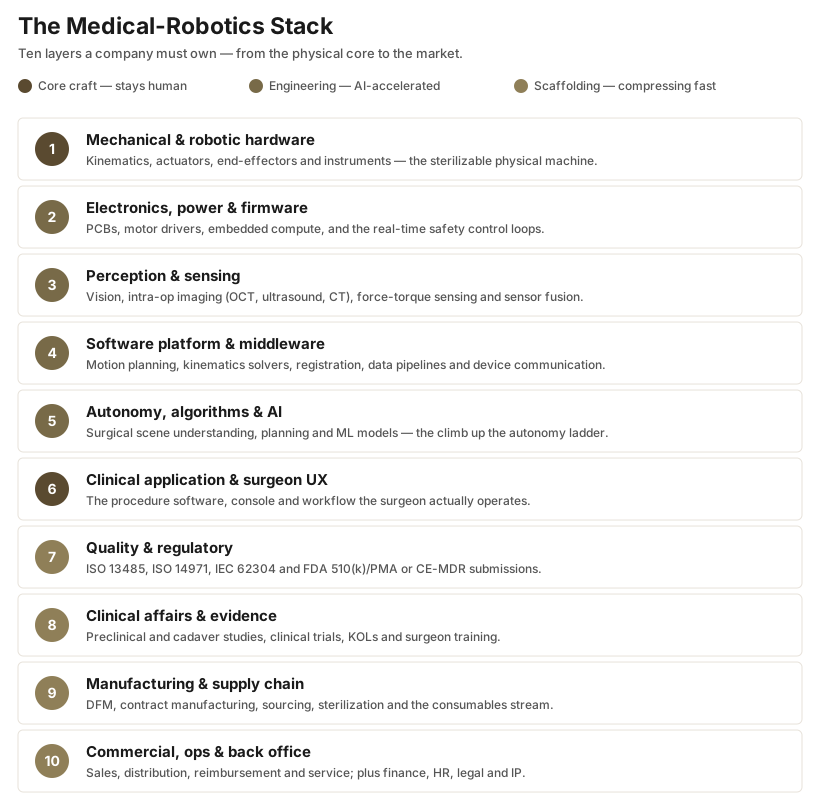
Today, the same company can be attempted by a team of 30–60. Not because the problem got easier — surgical robots are still surgical robots, and the physics has not been kind enough to relent — but because the layers around the physics have collapsed:
- The regulatory pathway can be mapped, drafted, and partially executed by a small team with AI-augmented workflows that would have required a dedicated department.
- The firmware and UI stack can be built by a handful of engineers operating agentic tools that compress months of work into weeks.
- The quality system (ISO 13485) can be stood up with a fraction of the documentation overhead.
- Mechanical iteration can happen faster because design review, simulation, and DFM analysis are increasingly within reach of any competent engineer with the right tools.
- Finance, HR, legal, and operations — the entire back office — can be run by two or three people, not twenty.
The craft remains: the surgical knowledge, the mechanical brilliance, the founder’s obsession with the patient outcome. That is still irreducibly human, irreducibly hard, and irreducibly the thing that determines whether the company succeeds. But the magnitude required to surround that craft with a viable company has collapsed by an order of magnitude.
What this means for the next decade
The implication is not that big companies will die. They won’t. Apple and Tesla will continue to exist and continue to dominate the categories where their scale advantages compound — particularly anything that depends on enormous capital deployment, physical distribution networks, or decade-long supply chain relationships. Scale still matters where atoms move at planetary volume.
The implication is that the categories big companies used to monopolize because of stack complexity alone are now open to small ones. Medical devices. Industrial robotics. Defense tech. Energy hardware. Climate infrastructure. Bio-tools. Semiconductor-adjacent products. Anywhere the bottleneck was “you need 300 people to even attempt this” — the bottleneck is moving toward “you need 30 people who are unusually good and unusually equipped.”
This is the single most important shift in how products get built since the rise of cloud computing, and it is happening faster than the cloud transition did. Cloud took a decade to reshape software economics. Agentic AI is reshaping product economics — across all layers, including the physical ones — in something closer to three years.
The vertical SME is no longer an oxymoron. It is becoming the default shape of the next generation of serious companies. Small teams, deep stacks, AI-augmented across every layer that used to require an army. The founders who understand this early — who stop assuming they need to pick a layer and start asking which entire product they could now plausibly own — are the ones who will build the next Apple, the next Tesla, the next ten of them.
Except this time, they will do it with sixty people instead of sixty thousand.
And that is the real story of what AI is doing to industry. Not job displacement. Not productivity gains at the margin. A fundamental compression in the magnitude required to build something whole. The stack is collapsing into the team. The team is becoming the company. And the company, for the first time in modern industrial history, can be small and vertical at the same time.
That has never been true before. It is true now.