Ten thousand years ago, a human being belonged to a handful of small, overlapping circles. There was the tribe, the band of hunters, the mothers gathered near the fire, the elders who remembered the floods, the children who would one day inherit the names. These were the original social graphs: dense, local, and built on a single resource — the time and attention of other people. You could only know as many faces as your evenings could hold. Cooperation was warm, slow, and bounded by the size of the camp.
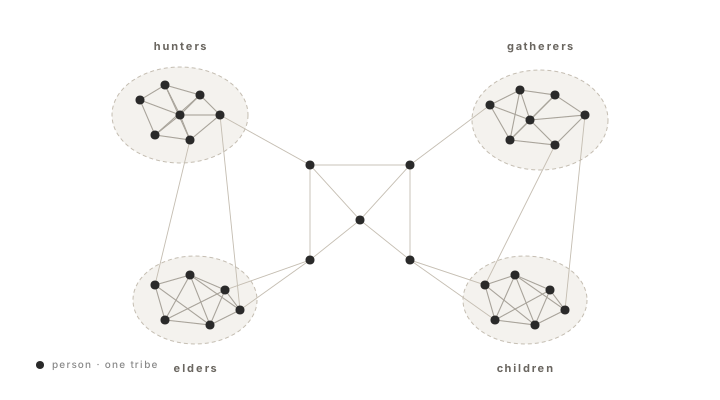
As villages turned into cities and cities into empires, the graph stretched. New nodes appeared that no Paleolithic ancestor would have recognized: the merchant who never met the farmer whose grain he sold, the bureaucrat who counted soldiers he would never command, the priest who spoke for gods nobody had seen. The graph thickened with strangers. To keep it from collapsing under its own weight, societies invented something deceptively simple — hierarchy. A pyramid is a compression algorithm for trust: it lets a king coordinate a million people he cannot name by passing instructions down a tree of intermediaries.
By the nineteenth century, the same shape had migrated into the new institution that would come to define modern life: the enterprise. Railways, steel mills, trading houses, and later the multinational corporation arranged themselves in tiers — a chief executive at the top, layers of managers in the middle, workers at the base. The org chart was not just an administrative convenience; it was a worldview. It told you who could speak to whom, whose signature mattered, where ideas were allowed to originate and where they were merely executed. For more than a hundred years, this was the dominant grammar of cooperative work.
Software companies inherited the grammar almost without thinking. A CTO at the top, directors below, engineering managers, tech leads, senior engineers, juniors. But something subtle was happening underneath the chart. The hierarchy was still there on the wall, yet the actual flow of work had become a graph — a web of pull requests, shared services, Slack threads, on-call rotations, and informal channels that ignored the pyramid almost entirely. The org chart said tree; the work said network. Companies pretended this was a contradiction to be solved. In practice, the hybrid was the source of their power.
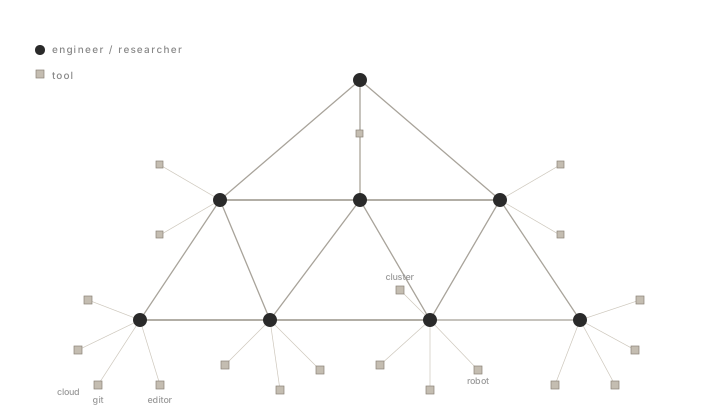
The reason the graph worked was that each node — each engineer — was no longer just a person. By the late 2010s, a single developer sat on top of a vertiginous stack of tools. There was the cloud, which had quietly turned the data center into an API call. There was Git, which had turned the entire history of a codebase into a graph of its own. There were editors that could autocomplete a thought, package managers that pulled in the work of strangers, dashboards that watched production at three in the morning so that humans did not have to. Each engineer was, in effect, a small command center wired into a planet-scale machine.
Specialized domains amplified this even further. In the robotics world, the engineer's “tool” was not just a compiler — it was the robot itself, a physical extension of the team, mediated by simulators, ROS graphs, motion planners, and fleets of sensors that streamed terabytes of the real world back into the codebase every night. In data and machine learning, the tool was a training cluster the size of a small town's power budget. In finance, it was a matching engine that moved more money in a second than the company's payroll did in a year. The pre-2022 picture was clear: a mixed hierarchical-and-graph society of human nodes, each one wielding a quietly enormous arsenal.
And there was no ambiguity, in that picture, about who counted. The first-class citizens of the graph were the people — the engineers, the researchers, the scientists who argued in front of whiteboards and signed off on releases. The tools, no matter how vast or expensive, were second-class: instruments held in human hands, named after the humans who wrote them, credited in papers whose authors were all carbon. This was so obvious it barely needed saying, and for that reason it was rarely said. It also seemed permanent. A compiler did not have a seat at the standup. A training cluster did not get promoted. The hierarchy between people and their machines felt less like a convention than a law of nature.
Then ChatGPT arrived, and at first it looked like one more entry in the arsenal. Another tool, slotted in beside the editor and the terminal. For a while that framing held. Through 2023 and into 2024, the model was something you talked to in a side panel. It wrote a function, drafted an email, summarized a meeting. But underneath the chat window, a quieter revolution was assembling itself: the Model Context Protocol, the agentic loops, the tool-calling standards, the long-running tasks that could read a repository and propose a change. Bit by bit, the chat box was growing hands.
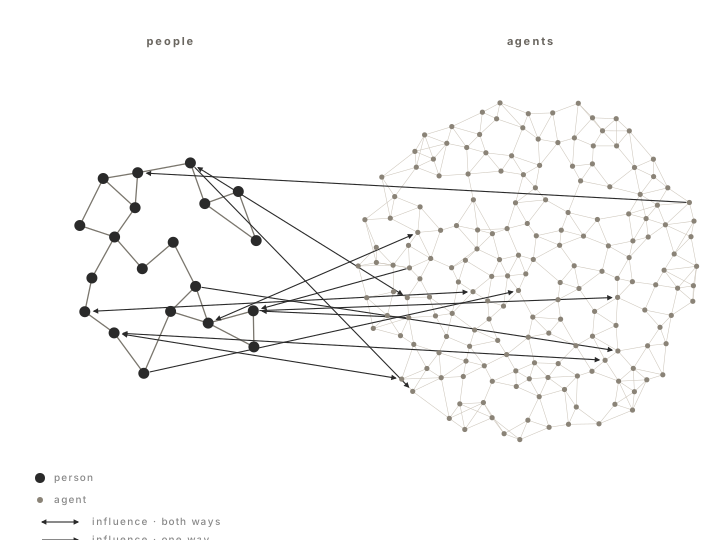
When Claude Code and its peers arrived in earnest, the framing finally cracked. The thing on the other side of the prompt was no longer a tool the engineer used — it was something closer to a colleague the engineer dispatched. And once you can dispatch one, you can dispatch ten, or a hundred, in parallel. The graph that had taken ten thousand years to evolve — tribes, cities, corporations, teams — quietly inverted. For each engineer, the surrounding “team” was no longer a group of other people. It was a fleet of agents, instantiated on demand, dissolved when the work was done. This is the pivot point, and we are living through it without ceremony.
The constraints on cooperation have, almost overnight, changed shape. For most of history, the binding limit on what a group could accomplish was the number of humans you could recruit, coordinate, and pay. Now, for a growing class of work, that limit has receded. What bounds an engineer's output today is, in rough order, three things: how much money is available to spend on inference, how much cloud capacity can be summoned, and — crucially — how clearly the product people, the designers, and the executives can express what production at scale actually needs. Articulation has become the scarce resource. The person who can say precisely what should exist is suddenly more valuable than the person who can type it.
For a brief and strange interval, the relationship will run both ways. Agents will serve the business, but people will also serve the agents — teaching them, demonstrating, correcting, supplying the worked examples that machines still need in order to generalize. Robotics offers the clearest preview: today, human operators are sent into warehouses and kitchens and operating rooms to show robots how a task is done, frame by frame, so that the robots can one day do it without them. The same pattern is forming in software, in design, in customer support, in legal work. It is an unusual transitional contract: the apprentices in this arrangement are the machines, and the masters are, for now, us. The next phase — in which machines plan, test, ship, manufacture, and manipulate the world with little intermediate human hand — is no longer a distant claim. It is the natural extrapolation of a graph that has been quietly rewriting itself since the first tribe sat down around the first fire.